richcathers.com
Old Testament Survey: Daniel - Malachi
CCEA School of Discipleship
Winter Trimester: 3:00-4:00pm
Before Class
Be sure to sign in.
Have each student wear a name tag
Welcome to our final Old Testament Survey Class … part 7.
This week we will be looking at what’s called the “Minor Prophets” of the Old Testament.
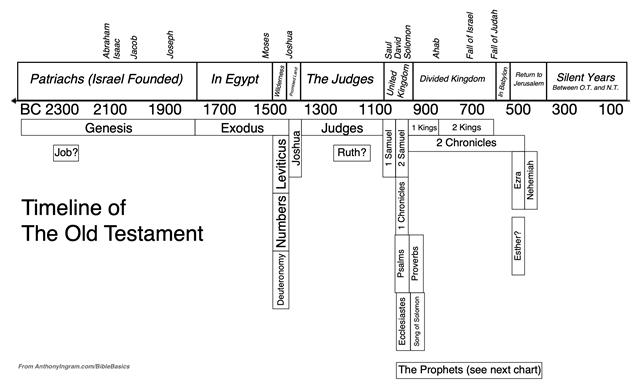
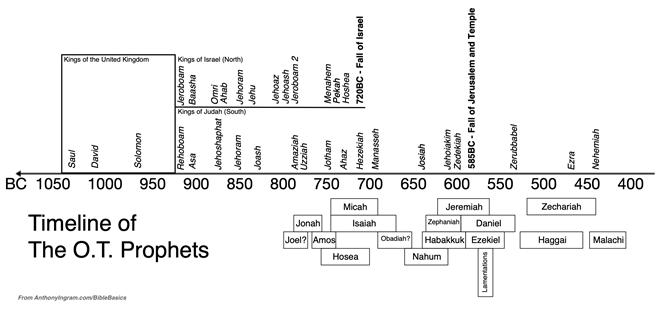
At the beginning of class I floated the idea of creating a “timeline” of the Old Testament.
I have to confess that coming up with an appropriate graphic myself has become a bit more than I can pull off at the moment.
I’ve found some materials by a fellow named Anthony Scott Ingram – and I am not endorsing him – but these graphics look to be pretty solid.
The first timeline shows an overview of the Old Testament.
The second timeline looks at the Prophets.
I hope you find these helpful. A copy will be in my notes and I’ll print out paper copies for the class.
Daniel
Author
Daniel
His name means “God is my judge”
When
605-534 BC
The Babylon Age
Daniel will actually outlive the Babylonian age and will live into the Persian age.
In particular, chapters 9-12 were written after the Persians began to rule.
Daniel lived a long, long life.
Why?
World Empires
Daniel was part of the first group of Jews taken captive to Babylon in 605 BC by Nebuchadnezzar to be trained and join his government.
We get a glimpse of young Jewish men who were committed to following God no matter what.
Daniel would refuse to follow the Babylonian diet.
Daniel’s friends would face the fiery furnace when they refused to bow to Nebuchadnezzar’s idol.
Daniel would survive the lion’s den when he refused to stop praying to God.
Yet because Daniel finds himself at the center of the world-ruling Babylonian government, the book is also filled with dreams and visions that will involve the changes in world empires.
He will interpret a dream of Nebuchadnezzar that will speak of the rise of the Persians, Greeks, and Romans.
Daniel himself will also have a parallel vision of these same empires.
Chapter 11 is one of the most amazing prophecies that details the rise of kings fighting over the Promised Land – including the wars of the Syrians and the Egyptians. It is so specific that many toss this out as having been written after the fact, when indeed it shows us that God knows the future.
Messianic
Daniel will give the exact date of the coming of the Messiah over 500 years before He would come.
(Daniel 9:25–26 NASB 2020)
—25 So you are to know and understand that from the issuing of a
decree to restore and rebuild Jerusalem, until Messiah the Prince, there
will be seven weeks and sixty-two weeks; it will be built again, with
streets and moat, even in times of distress. 26 Then after the sixty-two weeks, the
Messiah will be cut off and have nothing, and the people of the prince who is to come will destroy the city and the sanctuary. And its end
will come with a flood; even to the end there will be war; desolations
are determined.
It would take about twenty minutes to unpack this prophecy, but let me simply say this –
From the time that Artaxerxes gives the decree to rebuild the walls of Jerusalem, you can count down to the very day when Jesus arrives on Palm Sunday.
On that very day …
(Luke 19:41–42 NASB 2020)
—41 When He approached Jerusalem, He saw the city and wept over
it, 42 saying, “If you had known on this day, even you, the conditions for
peace! But now they have been hidden from your eyes.
Oh and by the way, there’s another example of “prophetic telescoping” in Daniel 9:26. There is a gap of several thousand years between the Messiah being “cut off” and the prince who is to come (antichrist).
Significant Verse
When Daniel’s three friends are threatened with the fiery furnace by King Nebuchadnezzar for not bowing down to his statue, they reply,
(Daniel 3:17–18 NKJV) —17 If that is the case, our God whom we serve is able to deliver us from the burning fiery furnace, and He
will deliver us from your hand, O king. 18 But if not,
let it be known to you, O king, that we do not serve your gods, nor will we
worship the gold image which you have set up.”
How can men like this ever be defeated?
Hosea
Author
Hosea
His name means “Salvation”
When
750-725 BC (roughly)
The Assyrian Age
As you read the book, you need to keep in mind there are two kingdoms in existence.
The northern kingdom is usually called … Israel (or, Ephraim, Samaria)
The southern kingdom is usually called … Judah (or, Jerusalem)
Why?
Israel’s idolatry
We’ve talked about how God often used the life of a prophet to teach lessons to the people.
Hosea’s life was one big illustration.
(Hosea 1:2 NASB 2020) When the Lord first spoke through Hosea, the Lord said to Hosea, “Go, take for
yourself a wife inclined to infidelity, and children of infidelity; for the
land commits flagrant infidelity, abandoning the Lord.”
God asks this man to marry a prostitute named Gomer.
They are to have kids together.
One of the kids was named “No mercy” because God was done having mercy on His people.
One of the kids was named “Not my people” (as in, who is your real father?)
Then, as if that’s not enough, Gomer goes back to work (as a prostitute).
And then God commands Hosea to go and bring her back.
All this was to impress on the people that God was aware that they were unfaithful to Him, and yet He was willing to take them back.
And he would change the names of the kids to “mercy” and “my people”.
Messianic
Hosea gives us little glimpses into God’s heart and the day when Jesus returns and reestablishes His relationship with Israel.
(Hosea 2:16 NLT) When that
day comes,” says the Lord, “you
will call me ‘my husband’ instead of ‘my master.’
Significant Verse
Last Wednesday night Pastor Bob called this Jesus’ favorite verse, because He quoted it so much:
(Hosea 6:6 NKJV) For I desire mercy and not
sacrifice, And the
knowledge of God more than burnt offerings.
When Jesus was being rebuked by the Pharisees for spending so much time with “sinners”, He replied with this from Hosea,
(Matthew 9:12–13 NKJV) —12 When Jesus heard that, He said to them, “Those who are well
have no need of a physician, but those who are sick. 13 But go and
learn what this means: ‘I desire mercy and not sacrifice.’ For I
did not come to call the righteous, but sinners, to repentance.”
Later, when Jesus’ disciples are criticized by the Pharisees for picking the heads of grain to eat on the Sabbath, part of Jesus’ reply was,
(Matthew 12:7 NKJV) But if you
had known what this means, ‘I desire mercy and not sacrifice,’
you would not have condemned the guiltless.
Joel
Author
Joel
His name means “Yahweh is God”
When
830 BC … or 609 BC ??
We aren’t sure when.
Assyrian age or Persian
Why?
The Day of the LORD
The book starts with an invasion of locusts destroying the fields, and that image becomes a picture of when Yahweh will judge the earth.
(Joel 2:1–2 NASB
2020) —1 Blow a trumpet in Zion, And sound an alarm
on My holy mountain! Let all the inhabitants of the land tremble, For the
day of the Lord is coming;
Indeed, it is near, 2 A day of darkness
and gloom, A day of clouds and thick darkness. As dawn
is spread over the mountains, So there is a
great and mighty people; There has never been anything like it, Nor will there be again after it To
the years of many generations.
Just as “the angel of the LORD” is a specific phrase to pay attention to in the Old Testament, so is the phrase “the day of the LORD”.
It can speak simply of any time of God’s judgment on someone or something.
It can speak generally of the end times.
It can speak specifically to that period that starts with the Rapture, the Tribulation, and the Second Coming of Jesus.
We’ll see in a minute it actually started at Pentecost
Quiz
1. The “day of the LORD” refers to:
a. A time of God’s judgment
b. Generally the entire “end times”
c. It started on the day of Pentecost
d. It includes the Rapture, Tribulation, and Second Coming
e. All of the above
Messianic
Peter will quote from Joel on the day of Pentecost to explain the outpouring of the Holy Spirit.
(Joel 2:28–32 NASB 2020) —28 “It will come about after this That I will pour out My Spirit on
all mankind; And your sons and your daughters will prophesy, Your
old men will have dreams, Your young men will see
visions. 29 “And even on the male and female servants I will pour out My Spirit
in those days. 30 “I will display wonders in the sky and on the earth, Blood, fire,
and columns of smoke. 31 “The sun will be turned into darkness, And the moon into blood,
Before the great and awesome day of the Lord
comes. 32 “And it will come about that everyone who calls on the name
of the Lord Will be saved; For on
Mount Zion and in Jerusalem There will be those who escape, Just
as the Lord has said, Even among the survivors whom the Lord calls.
There are so very many pictures all mashed together here.
You see the day of Pentecost with the pouring out the Spirit, vs.28.
This is part of the “day of the LORD”. Pastor Bob has pointed out that technically the “end times” started on the day of Pentecost, and that concept comes from Peter quoting this passage on the day that the Holy Spirit was poured out on the church in Acts 2.
You see the Tribulation (vs.30-31), which is also quoted by Peter at Pentecost.
You see the essence of how a person is saved (vs.32), which Paul quotes in Romans 10.
(Romans 10:13 NASB 2020) for “Everyone who calls on the name of the Lord
will be saved.”
But Paul even clarifies what it means to “call on the name of the LORD” (notice in Joel that it’s “Yahweh” in the Hebrew) in Romans 10:9…
(Romans 10:9 NASB 2020) that if you
confess with your mouth Jesus as Lord, and believe in your heart
that God raised Him from the dead, you will be saved;
Some people teach this means that unless Jesus is your complete and total “Lord” of your life, you can’t be saved. Some will even twist this to say that if you goof up in your life, you aren’t saved.
But what Paul is saying by referencing Joel is that you need to believe and confess that Jesus is “Yahweh”, that Jesus is God. Joel said that whoever calls on the name “Yahweh” will be saved.
Significant Verse
Being an “old man”, I’ll pick this verse,
(Joel 2:28 NASB 2020) “It will come about after this That I will pour out My Spirit on
all mankind; And your sons and your daughters will prophesy, Your
old men will have dreams, Your young men will see
visions.
Amos
Author
Amos
His name means “burden”
The words that an Old Testament prophet would receive were sometimes called a “burden”.
Before becoming a “prophet”, he was a “sheepbreeder” and a tender of “sycamore” fruit (Amos 7:14).
When
750 BC
The Assyrian Age
Halley has an interesting note about the other prophets that would have been alive in Amos’ day, that the likelihood that Amos even knew them.
Those prophets include Jonah, Elisha (and knowledge of Elijah) – and these fellows were in their older years when Amos came along.
Joel and Hosea may have also been around in Amos’ time.
Isaiah and Micah would have been starting their ministries when Amos was ending his.
Why?
The end is near
For the northern kingdom.
Keep in mind you will need to remember to navigate the terms of “Israel” vs. “Judah”, as well as “Samaria” vs. “Jerusalem”, just like the other “Assyrian Age” prophets.
Messianic
(Amos 9:13 NASB 2020) “Behold, days are coming,”
declares the Lord, “When the
plowman will overtake the reaper, And the one who treads grapes will
overtake him who sows the seed; When the mountains will drip grape juice, And all the hills will come apart.
This speaks of the nation after Jesus returns the second time.
There will be so much bounty in the fields that the guy who is trying to plow the field for the next planting will keep bumping into the guy who is still reaping the last harvest.
Obadiah
Author
Obadiah
His name means “servant of Yahweh”
When
848 BC or 585 BC
Good scholars disagree on the dating.
I prefer to think it’s written soon after the destruction of Jerusalem (585 BC)
The Assyrian Age / The Babylonian Age
Why?
Destruction of Edom
Edom was the kingdom to the east of Israel across the Dead Sea and the perennial enemy to Israel.
It was made up of the descendants of Esau, the twin brother of Jacob.
(
This is the shortest book of the Old Testament, only 21 verses
Messianic
I think Obadiah foreshadows the judgment that’s coming after Jesus returns.
(Obadiah 15 NASB 2020) “For the day of the Lord is near for all the nations. Just
as you have done, it will be done to you. Your dealings will return on your own head.
Again, the “day of the LORD”.
Jesus’ return will involve the destruction of Israel’s enemies.
Significant Verse
(Obadiah 12 NASB 2020) “Do not gloat over your
brother’s day, The day of his misfortune. And do not rejoice over the sons of
Judah On the day of their destruction; Yes, do not
boast On the day of their distress.
God would bring judgment on Edom because they gloated in Judah’s defeat.
Jonah
Author
Jonah
His name means “dove”
When
770 BC
The Assyrian Age
Jonah lived in the northern kingdom of Israel, and helped to guide King Jeroboam II. He’s even mentioned in the book of 2Kings which is talking about Jeroboam II:
(2 Kings 14:25 NASB 2020) He restored the border of Israel from the entrance of Hamath as far
as the Sea of the Arabah, in accordance with the word of the Lord, the God of Israel, which He spoke
through His servant Jonah the son of Amittai, the prophet, who was from Gath-hepher.
(Gath-hepher was part of the tribe of Zebulun, one of the northern tribes near Galilee)
Why?
Nineveh needs saving
This is a story that you all probably know.
God says “Go”.
Jonah is sent to deliver a message to Nineveh, the capital of the Assyrian empire – a very wicked, ruthless people.
Jonah says “No”.
Jonah doesn’t want to go because he wants the Assyrians to be judged by God.
As Jonah is setting off in a boat, there’s a storm, then a fish … and you know the rest.
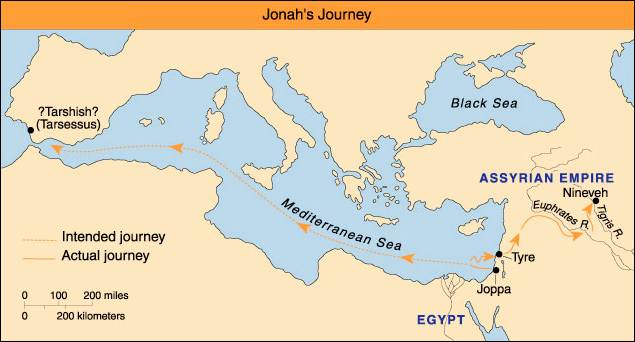
There is one part that most people don’t get right. (see map from Halley)
Jonah leaves on a boat from Joppa.
He heads towards Tarshish (Spain).
When the fish spits him out, it’s somewhere along the coast of the Mediterranean Sea (Halley’s map says Tyre)
Nineveh is on the Tigris River
Jonah was NOT spit out at Nineveh. He still had several hundred miles to walk to get to Nineveh. I’ve heard famous pastors talk about how Jonah was such a strange looking man having been spit out by the fish with bleached hair having been in the fish’s belly. Yet he still had weeks to travel to get to Nineveh.
Messianic
(Jonah 1:17 NASB 2020) And the Lord designated a great fish to swallow
Jonah, and Jonah was in the stomach of the fish for three days and three
nights.
Note: It doesn’t say it was a “whale”, but a “great fish”. There are several types of fish that could have done this and there have been a few others who have been swallowed by fish and lived.
Three days … Jesus took this for His own …
(Matthew 12:39–40 NASB
2020) —39 But He answered and said to them, “An evil and adulterous
generation craves a sign; and so no sign will be given to it except the
sign of Jonah the prophet; 40 for just as Jonah was in the stomach of the sea monster for three days and three
nights, so will the Son of Man be in the heart of the earth for three
days and three nights.
He was speaking of His death and resurrection.
Significant Verse
You are all aware that Jonah did go to Nineveh to preach. His only message was “Yet forty days, and Nineveh shall be overthrown”.
When the people of Nineveh heard this message, they repented, and God was merciful and withdrew the judgement.
I think Jonah’s response is quite amazing (in a head-scratching kind of way)
(Jonah 4:2 NASB 2020) Then he prayed to the Lord and said, “Please Lord, was this not what I said when I
was still in my own country? Therefore in
anticipation of this I fled to Tarshish, since I knew that You are a
gracious and compassionate God, slow to anger and abundant in mercy, and One who relents of disaster.
Jonah had been afraid that God was going to be merciful to these people that he hated.
But what a testimony of God’s mercy!
Micah
Author
Micah
His name means “Who is like God?”
And no, this is not the prophet Micah, but this is the last of my four grandkids (named Micah) to sneak a picture for you…
And as an end of semester bonus … (Micah chasing Ruthie)
When
740 BC
The Assyrian Age
Micah would have been a contemporary of Isaiah and Hosea.
He was from Moresheth, about 30 miles southwest of Jerusalem near the Philistine city of Gath.
Why?
Judgment for Samaria and Jerusalem
This will be another book where you need to keep your eyes open between the difference between “Israel” and “Judah”.
Messianic
Micah is the one who pinpoints the Messiah’s birthplace.
(Micah 5:2 NASB 2020) “But as for you, Bethlehem
Ephrathah, Too little to be among the clans of Judah, From
you One will come forth for Me to be ruler in Israel. His times of coming forth
are from long ago, From the days of eternity.”
This is the verse that the Jews passed on to the Wise Men when they came looking for the Messiah.
This again links Messiah to David (who came from Bethlehem).
This tells us that the Messiah didn’t start in Bethlehem, but has been around since eternity.
Significant Verse
When Jesus was giving a stern rebuke to the Pharisees, He mentions something that I think hints back to Micah –
(Matthew 23:23 NASB 2020) “Woe to you, scribes and
Pharisees, hypocrites! For you tithe mint and dill and cumin,
and have neglected the weightier provisions of the Law: justice and
mercy and faithfulness; but these are the things you should have
done without neglecting the others.
I wonder if is what Jesus may have been hinting at…
(Micah 6:8 NKJV) He has shown you, O man, what is
good; And what
does the Lord require of you But to do justly, To love mercy, And to walk
humbly with your God?
Jesus uses at least two of the three components of Micah’s verse.
We can lose sight of what’s really important. This is really important.
Nahum
Author
Nahum
His name means “comfort”
We think that the New Testament city of Capernaum carries his name – “the village of Nahum”
When
650 BC
The Babylonian Age
Why?
The fall of Nineveh
Nahum writes 120 years after Jonah’s “revival” in Nineveh.
The Assyrian empire has already fallen to the Babylonians, yet this zeroes in on the destruction of the capital city, Nineveh.
The city was destroyed by the Babylonians forty years later in 612 BC.
Messianic
(Nahum 1:2 NASB 2020) A jealous and avenging God is
the Lord; The Lord is avenging and wrathful. The Lord takes vengeance on His
adversaries, And He reserves wrath for His enemies.
Though not specifically Messianic, when Jesus returns, He will bring vengeance on the enemies of God’s people.
We see this vengeance taking place on Nineveh in the book of Nahum.
Significant Verse
Though much of the book is aimed at God’s judgment on Nineveh, this stands out –
(Nahum 1:7 NASB 2020) The Lord is good, A stronghold in the day of trouble, And He
knows those who take refuge in Him.
Habakkuk
Author
Habakkuk
His name means “embrace”
When
607 BC
The Babylonian Age
We think he probably wrote during the reign of King Jehoiakim, who was a wicked king in Judah.
Why?
Questions
Instead of having prophecies about nations, Habakkuk is a man who is asking God questions.
He asks questions like, “Why don’t you answer my prayers?” or “Why are you doing this?”
And God answers his questions.
Messianic
One of the key components to New Testament faith comes from Habakkuk.
(Habakkuk 2:4 NASB 2020) “Behold, as for the impudent
one, His soul is not right within him; But the righteous one will live by his faith.
It’s that last phrase that sparks much in the New Testament.
He’s not saying that the righteous person uses his faith, but that he actually finds “life”, “eternal life” through faith.
Paul talks about the gospel and repeats this verse in:
(Romans 1:17 NASB 2020) For in it the
righteousness of God is revealed from faith to faith; as it is written: “But the righteous one will live by
faith.”
And again in
(Galatians 3:11 NASB 2020) Now, that no one is justified
by the Law before God is evident; for, “the
righteous one will live by faith.”
We aren’t justified by the Law, but by having faith in God.
And then we find it in Hebrews as well. The writer is talking about the need for endurance, and he writes,
(Hebrews 10:38 NASB 2020) But
My righteous one will live by faith; And
if he shrinks back, My soul has
no pleasure in him.
Significant Verse
I love this demonstration of faith found in the end of Habakkuk’s little book:
(Habakkuk 3:17–19 NASB
2020) —17 Even if the fig tree does not blossom, And there is no fruit on the
vines, If the yield of the olive fails, And the fields produce no food, Even
if the flock disappears from the fold, And there are no cattle in the
stalls, 18 Yet I will
triumph in the Lord, I
will rejoice in the God of my salvation. 19 The Lord God is my strength, And He has made my
feet like deer’s feet, And has me walk on my
high places.
Zephaniah
Author
Zephaniah
His name means “Yahweh has treasured” or “Yahweh has hid”
He was a great-great-grandson of King Hezekiah.
When
625 BC
The Babylonian Age
He would have been part of the revival that came during the reign of King Josiah.
Why?
The Day of the LORD
Though we sometimes mistakenly limit this phrase to talk about the Second Coming, it is used here to describe the coming Babylonian invasion of Judah.
Zephaniah is warning the nation of the coming Babylonian judgment.
Messianic
The end of his prophecy looks forward to the time when Jesus will set up His kingdom. I’ll let this verse double as our “significant” verse:
(Zephaniah 3:17 NASB 2020) “The Lord your God is in your midst, A victorious warrior. He will
rejoice over you with joy, He will be quiet in His love, He will rejoice over
you with shouts of joy.
Haggai
Author
Haggai
His name means “festive”
When
535 BC
The Persian Age
Why?
Finish the Temple
Haggai was part of the group that came back to Jerusalem from Babylon.
After laying the foundation of the Temple, the people got stalled and quit building.
Ezra records,
(Ezra 5:1–2 NASB 2020) —1 When the prophets, Haggai the prophet and Zechariah the son of
Iddo, prophesied to the Jews who were in Judah and Jerusalem in the name of
the God of Israel, who was over them, 2 then
Zerubbabel the son of Shealtiel and Jeshua the son of Jozadak
rose up and began to rebuild the house of God which is in Jerusalem; and the
prophets of God were with them, supporting them.
Our book here contains the messages that Haggai gave over a five month period.
Messianic
(Haggai 2:9 NASB 2020) ‘The latter glory of this
house will be greater than the former,’ says the Lord of armies, ‘and in this place I will give peace,’
declares the Lord of armies.”
Why would this temple which they built have greater glory?
Because Jesus would one day walk in this temple.
Significant Verse
Haggai’s words still speak to us today when our priorities are off:
(Haggai 1:9 NASB 2020) “You start an
ambitious project, but behold, it comes to little; when you bring it
home, I blow it away. Why?” declares the Lord of armies. “It is because of My house which remains
desolate, while each of you runs to his own house.
The people were more concerned about building their own houses than they were in rebuilding the Temple.
Zechariah
Author
Zechariah
His name means “Yahweh remembers”
When
534-532 BC
The Persian Age
Zechariah will pick up where Haggai leaves off.
Why?
Rebuild, Messiah is coming
Zechariah’s ministry will also be about finishing the Temple, but he goes way beyond that to give us some amazing prophecies about the Messiah.
Messianic
Here are just a few (by no means all of them)
First Coming:
(Zechariah 9:9 NASB 2020) Rejoice greatly, daughter of
Zion! Shout in triumph, daughter of Jerusalem! Behold, your king is
coming to you; He is righteous and endowed with salvation, Humble, and mounted
on a donkey, Even on a colt, the foal of a donkey.
This was Palm Sunday
(Zechariah 11:13 NASB 2020) Then the Lord said to me, “Throw it to the
potter, that magnificent price at which I was valued by them.” So I took the thirty shekels of silver and
threw them to the potter in the house of the Lord.
How much Judas was paid to betray Jesus.
(Zechariah 13:7 NASB 2020) “Awake, sword, against My
Shepherd, And against the Man, My Associate,” Declares
the Lord of armies. “Strike the
Shepherd and the sheep will be scattered; And I will turn My hand
against the little ones.
Jesus will be abandoned by His disciples
Second Coming:
(Zechariah 12:3 NASB 2020) It will come about on that
day that I will make Jerusalem a heavy stone for all the peoples; all who lift
it will injure themselves severely. And all the nations of the earth will be
gathered against it.
The nations will be gathered to attack Jerusalem before Jesus returns.
(Zechariah 12:10 NASB 2020) “And I will pour out on the
house of David and on the inhabitants of Jerusalem the Spirit of grace and of
pleading, so that they will look at Me whom they pierced; and they will
mourn for Him, like one mourning for an only son, and they will weep bitterly
over Him like the bitter weeping over a firstborn.
The Jews will “look on Him whom they have pierced”. Wow! John tells us this will happen when Jesus comes back (Revelation 1)
(Zechariah 14:3–4 NASB
2020) —3 Then the Lord will go
forth and fight against those nations, as when He fights on a day of battle. 4 On that day His feet will stand on the Mount of Olives,
which is in front of Jerusalem on the east; and the Mount of Olives will be
split in its middle from east to west forming a very large valley. Half
of the mountain will move toward the north, and the other half toward the
south.
This is when He returns to save Jerusalem.
And there’s much, much more…